Brad mentioned in a recent post that they have been learning a lot of things about the universe that they hadn't known before while making Star Control Origins. That made me think of this, which some of you may have heard of before but many people haven't and wouldn't think a thing like this could actually be a part of real science.
Quantum mechanics is pretty much the height of our understanding of the universe, and this is one of the most famous experiments in all of quantum mechanics. The video below is only about 5 minutes long and explains it fairly well.
Not sure if this thread is in the proper place (is there a Misc subforum?), anyway:
Yeah the double-slit experiment is pretty cool. The three theories to explain how the electron can go through both slits at once are the Copenhagen Interpretation, Many-worlds, and Broglie-Bohm Pilot-wave theory (relativistic part currently missing). Each theory has its weird parts (see below video for explanation of Pilot-wave theory and see the two videos the below video references for explanations of many-worlds and the Copenhagen interpretation).
There is a similar experiment called Frustrated Total Internal Reflection. PBS Space Time and Fermilab are really good YouTube channels. The below YouTube video is from PBS Space Time and it's a really good introduction you should watch before continuing. Then at 6:12 they mention an experiment that showed that light can tunnel through a gap between a tunneling barrier and a beam splitter and that it does so instantaneously and may violate causality but only on the tiny scale of the uncertainty in its wave function (the DeBroglie wavelength). I'll explain the previous sentence in the next paragraph. Whether or not the photon tunnels is a probability based on how big the tunneling barrier is (the bigger the barrier the less likely that the tunneling happens). Since it is only a probability we cannot send information through this tunneling faster-than-light. Another example is quantum entanglement, where there is "spooky action at a distance" but it is a coin flip chance as to what the spins of the two particles end up to be, so it is only a probability we cannot send information through this. Another example is shining a flashlight at night and swinging it from one star to another. The flashlight shines out from Earth at the speed of light and the swing is faster than light, but the swing cannot carry any faster-than-light information because the swing has to wait for the shining out from Earth to get there and the shining is light-speed. Notice the pattern here. Faster-than-light is allowed in some cases but cannot transmit information faster-than-light.
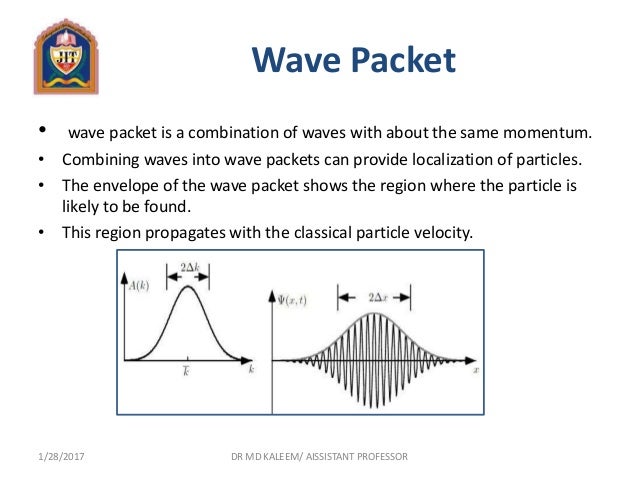
First we need to understand what a quantum is. You can think of it as a wave packet. You can see in the below slide that a wave packet has the waviness of a wave but in a confined space and that space can be thought of like a particle. So that is how the mathematics of quantum mechanics gets the quantum to behave both like a billiard ball and a pond ripple. More specifically the position, energy/velocity, and temporal location of a particle are a balance of probabilities that balance based on the Heisenburg Uncertainty Principle. The more precisely we measure the position the less accurately that measurement can measure the other two. The more precisely we measure the energy/velocity the less accurately that measurement can measure the other two. The more precisely we measure the time the less accurately that measurement can measure the other two. This is what the previous means in how the particle behaves: The more we know the position the more the quantum acts like a billiard ball (remember when the OP's video talked about observing the position of the electron before entering the slits causes it to change from wave-like to billiard-ball-like behavior this is why) and the more we know the energy/velocity the more the quantum acts like a wave. I'm not sure what happens when we know time really well. The below gif image is failing to show for me. If it fails for you please use this link to see it instead: http://abyss.uoregon.edu/~js/images/position_energy_time.gif
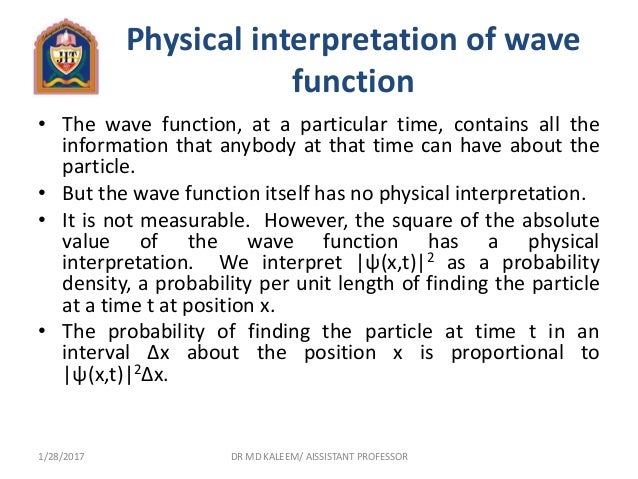
The second slide explains the wave function. The important thing to notice is the wave function contains all of the information about the quantum at a particular time but "has no physical interpretation". The square of the absolute value of the wave function is what describes the probability of where the quantum's physical location is. The Frustrated Total Internal Reflection experiment shows that while the photon is quantum tunneling between the two glass plates the photon is not actually there. The square of the absolute value of the wave function for the photon shows it approaching the first glass plate, but between the first and second glass plates the square of the absolute value of the wave function is zero. But the simple wave function itself between the two glass plates is not zero. What is the wave function doing between the plates? Well if we look between the glass plates to try to observe the wave function there then we see nothing and Frustrated Total Internal Reflection stops happening (the photon reflects off the first plate instead of quantum tunneling between the two plates and continuing on its way) because the quanta we use to observe the space between the plates makes the wave function between the plates go to zero. This proves that the light really is not there between the plates and that while we are not observing that gap the wave function really does in some sense carry the photon through the gap even though the wave function has no physical interpretation.
"A wave packet can be visualized as a pulse, or a localized disturbance in some medium. It can be a wave of anything--light, sound, matter waves, etc. ... Some wave functions count as wave packets, but not all of them. For example, if the wave function of an electron is a wave packet, then we say the electron's matter wave is localized in space."
Yes, there are many interesting aspects to quantum mechanics, even with what little I know of it. The most fascinating thing too me about the Double Slit experiment is that the physics of what is happening actually change if you attempt to measure/observe what is happening. Like it says in the video "as if the universe knows that it is being watched" and, I add "and doesn't want you to know how that works". This is a big part of the "pseudo-science" basis of my own "living universe", the thing that roots that aspect of it in real science. But, obviously, is also a very interesting real-world subject all on it's own.
I find it equally fascinating that the Frustrated Total Internal Reflection experiment shows that a quantum can travel (instantaneously teleport) while not existing.
I don't generally "believe" things, and don't know nearly as much about quantum mechanics as you do.
It would be more accurate to say that I am fascinated by the idea that the entire universe is a single living entity, that we are all a part of. That single living entity would be what we perceive as "god", although it isn't actually a "god". The idea that the answer to the Double Slit experiment is "the universe knows that we are looking at this aspect of it, and it doesn't want us to have this information" is just a really cool idea too me. This has wound up being very influential in my own sci-fi story. So I have contemplated this a lot as a basis for fiction, and not in terms of real science.
If you just make up nonsense to base "pseudo-science" on, that's how it comes across. As nonsense. It needs to be tied, even by the tiniest sliver of real science, to real science. My story had already had this concept running through it, but when I discovered this Double Slit experiment a few years ago I was just ecstatic about the whole thing. It is the perfect "sliver of real science" to hang a story of a "living universe" on and give it real world credibility.
Like how Roddenberry's warp drive was based on the "sliver of real science" that space is curved, so a warp drive is "leaving the natural curvature of space-time and taking a more direct path too its destination". Too me, the Double Slit experiment is my personal version of that.
The Copenhagen Interpretation (the most popular model) really does care about whether or not the observer is looking (whether or not there is decoherence, the most extreme example being Schrödinger's Cat) just as you said. I think that part actually is based in real science, although it is the most controversial part of the Copenhagen Interpretation because putting such importance on an observer is anthropocentric. By the way, what is your sci-fi story?
You might enjoy this quote:
Einstein was not prepared to let us do what, to him, amounted to pulling the ground from under his feet. Later in life, also, when quantum theory had long since become an integral part of modern physics, Einstein was unable to change his attitude-at best, he was prepared to accept the existence of quantum theory as a temporary expedient. "God does not throw dice" was his unshakable principle, one that he would not allow anybody to challenge. To which Bohr could only counter with: "Nor is it our business to prescribe to God how He should run the world."
Werner Heisenberg, Physics and Beyond (1969), Ch. 6 : Flesh Fields
Also you might enjoy that a Star Trek warp drive is mathematically possible in General Relativity's equations. The only problem is the requirement for a ring of "negative mass" and no stable particle yet discovered has negative mass.
Haha, I can't count the times that I have posted a link to Alcubierre's warp drive into different discussions, haha. I have been pointing out too people for many years that E=MC2 only means that you can't accelerate mass to the speed of light by conventional means. There are many ways of getting from point A to point B at a speed that would appear to be faster than light to an outside observer that are already been at least theorized by science. Wormholes, folding space, and Alcubierre's warp drive just a few examples of that. Getting from point A to point B at a speed that appears to be faster than light is not "impossible in real science, only accelerating a mass to that speed by conventional means is "impossible" by real science.
My story has never been published. There is a preview of it on my GameDev.Net blog...
...but the blog wasn't just about the story so there is other stuff mixed in with it. This link is the overview of the whole universe and the Armageddon Chess download is an entire first draft of the beginning of the story. It basically my own "rock & roll sci-fi universe" that is intentionally sometimes a little bit "crazy" or "off-the-wall".
A big part of the inspiration for the "living universe" aspect of the PDU where the lyrics too this song, which most will probably find very intriguing even if they have no interest in my story.
Discovering the Double Slit experiment was such a great thing too me because it roots the whole "living universe" thing with real science, even if just by a tiny little sliver.
Copenhagen Interpretation (your "living universe" that decoheres when you observe it, see Schrödinger's Cat thought experiment)
End of Prof_Hari_Seldon's quote
Just a quick jump-in: The entire point of "Schrödinger's Cat" wasn't to highlight that theory, it was to show how ridiculous he thought the theory was. The idea that the cat could exist in a superstate until its state was measured was, to him, stupid.
These days, people hold up the cat story as some awesome proof or demonstration of the theory, which is pretty much 180 degrees to what the point of it was
Welcome Guest! Please take the time to register with us.
Richer content, access to many features that are disabled for guests like commenting and posting on the forums.
Access to a great community, with a massive database of many, many areas of interest.
Access to contests & subscription offers like exclusive emails.

 StarControl Forums